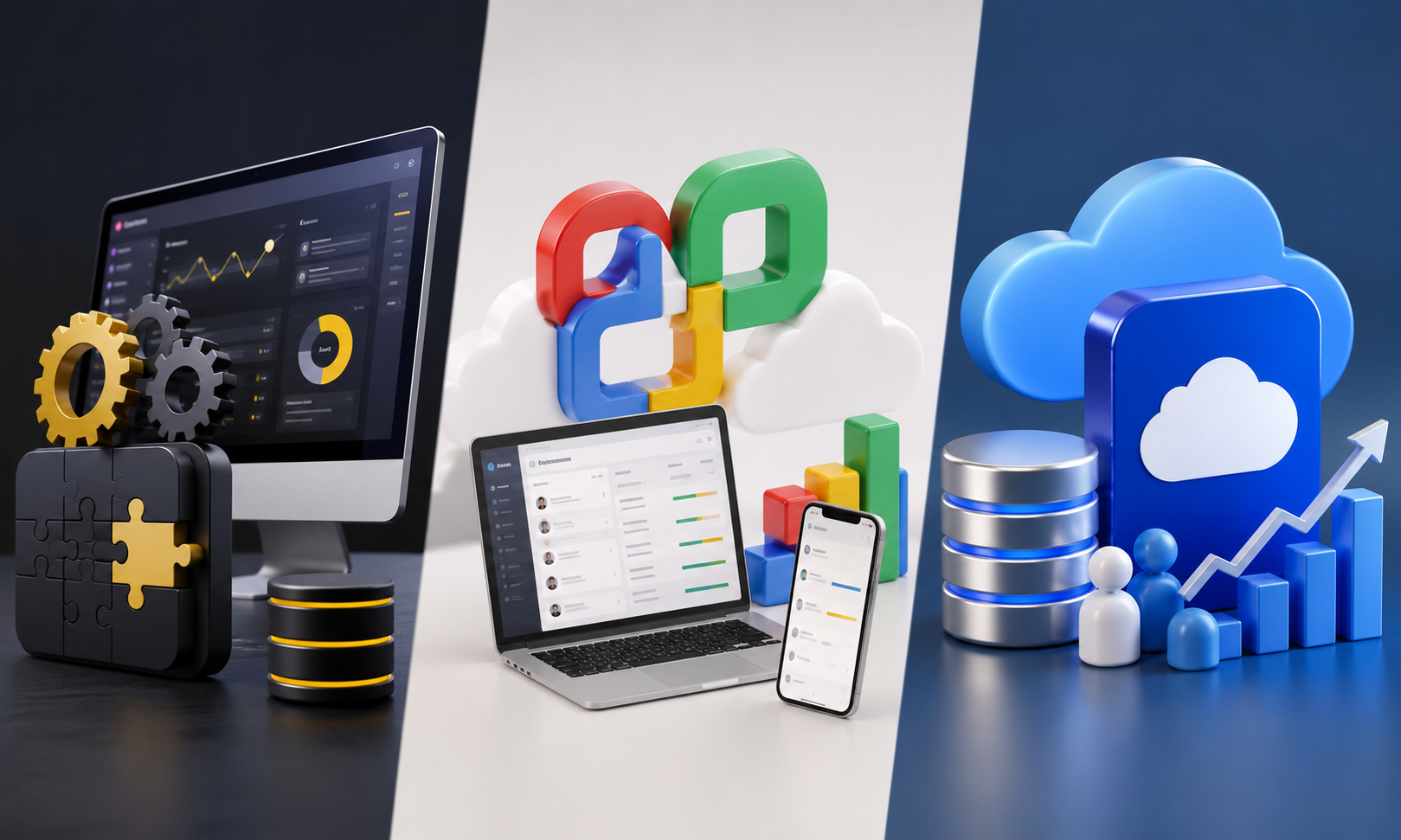
As businesses grow, spreadsheets, email threads, and disconnected tools quickly become difficult to manage. Sales teams lose follow-ups, customer service becomes inconsistent, and business leaders struggle to access accurate reports. A Customer Relationship Management (CRM) system addresses these challenges by centralizing customer information and streamlining business processes.
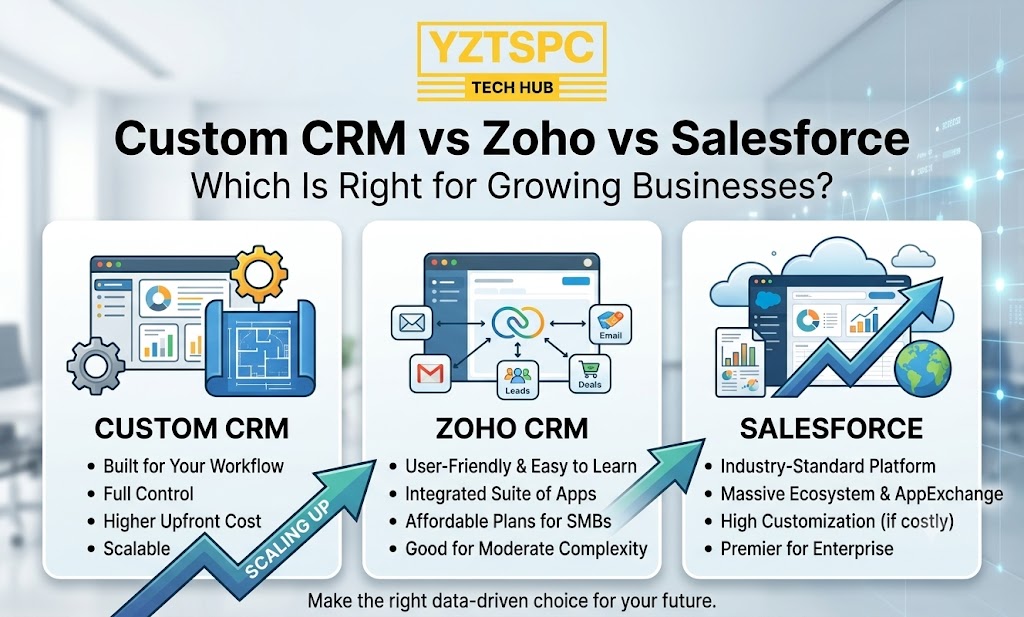
One of the biggest decisions growing businesses face is choosing between a Custom CRM, Zoho CRM, or Salesforce. Each option has strengths, limitations, and ideal use cases. The right choice depends on your business model, budget, operational complexity, and long-term growth plans.
This guide compares these three CRM approaches to help you make an informed investment.
Quick Answer
| Business Need | Best Choice |
|---|---|
| Small business with standard sales processes | Zoho CRM |
| Enterprise requiring advanced ecosystem and scalability | Salesforce |
| Businesses with unique workflows and long-term flexibility | Custom CRM |
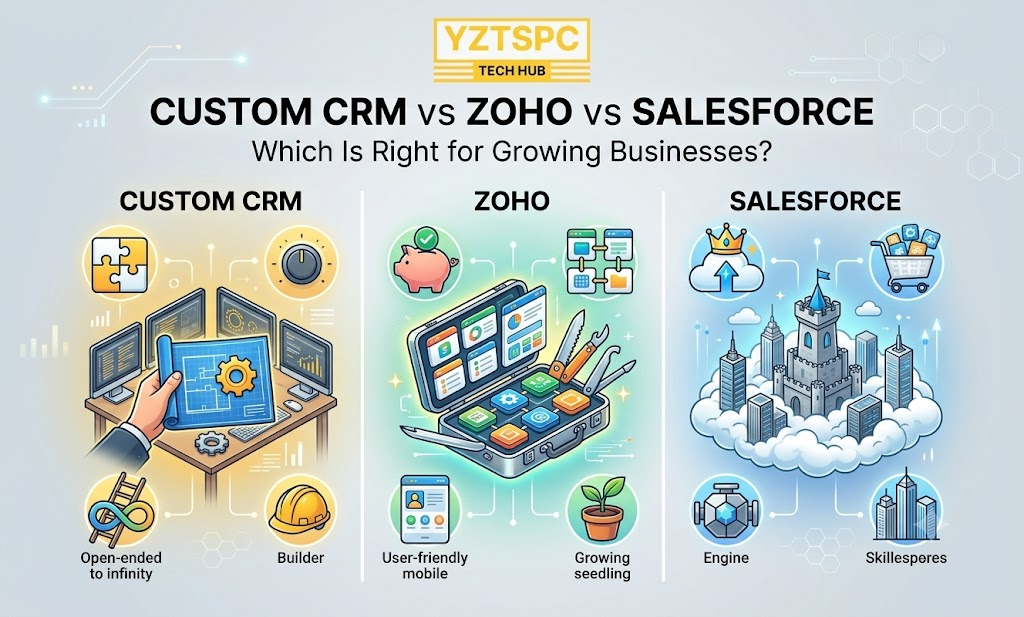
What Is a CRM?
A Customer Relationship Management (CRM) platform helps businesses manage customer interactions throughout the customer lifecycle.
A CRM can help you:
- Track leads and opportunities
- Manage customer communication
- Automate repetitive tasks
- Generate sales reports
- Improve customer service
- Increase sales productivity
- Centralize business information
Instead of scattered spreadsheets and emails, your entire customer journey is managed in one secure system.
Understanding the Three CRM Options
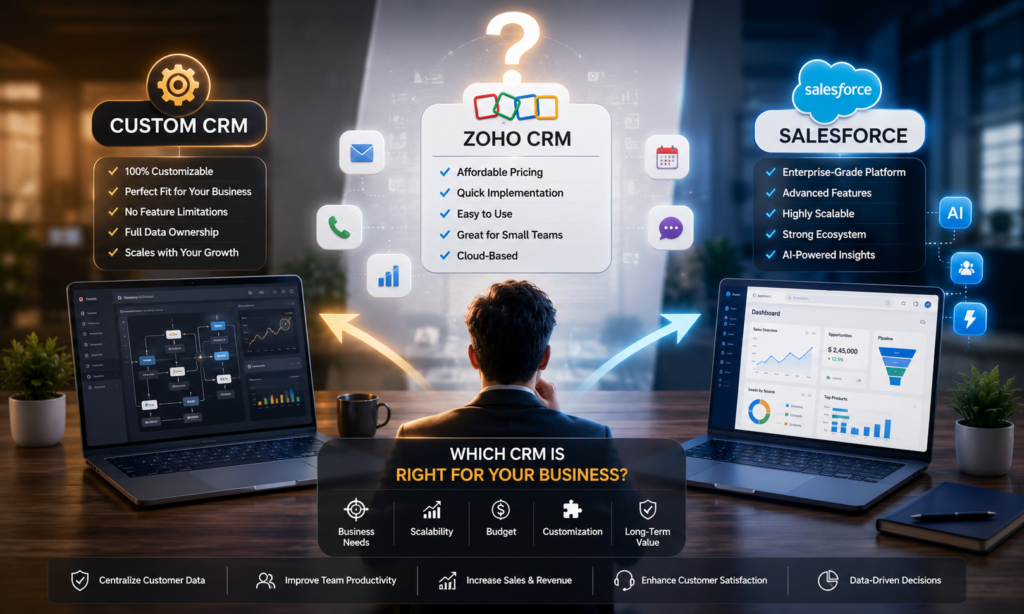
Custom CRM
A Custom CRM is designed specifically for your organization’s workflow, departments, approval process, reporting structure, and operational requirements.
Unlike off-the-shelf software, every feature is built around your business rather than requiring your business to adapt to predefined software.
Typical users include:
- Manufacturing companies
- Logistics businesses
- Healthcare organizations
- Educational institutions
- Service businesses
- Companies with specialized workflows
Zoho CRM
Zoho CRM is a cloud-based CRM platform designed for startups and small to medium-sized businesses.
It offers many ready-made features including:
- Lead management
- Sales automation
- Email integration
- Workflow automation
- Dashboards
- Mobile applications
Zoho’s biggest advantage is affordability and quick deployment.
Salesforce
Salesforce is one of the world’s largest enterprise CRM platforms.
It offers:
- Advanced automation
- AI-powered insights
- Enterprise integrations
- Large application marketplace
- Highly scalable infrastructure
- Extensive customization capabilities
It is widely adopted by medium and large organizations operating across multiple teams and regions.
Feature Comparison
| Feature | Custom CRM | Zoho CRM | Salesforce |
|---|---|---|---|
| Initial Cost | Higher | Low | Medium to High |
| Monthly Subscription | No recurring license (unless hosted as SaaS) | Yes | Yes |
| Customization | Unlimited | Moderate | High |
| Scalability | Excellent | Good | Excellent |
| Integration Flexibility | Unlimited | Good | Excellent |
| Ownership | Complete | Vendor-controlled | Vendor-controlled |
| Implementation Time | Longer | Fast | Medium |
| Learning Curve | Based on your design | Easy | Moderate to Advanced |
When a Custom CRM Is the Better Choice
Many businesses eventually realize that standard CRM platforms cannot fully support their internal processes.
A custom CRM becomes valuable when your organization has:
Unique Business Processes
For example:
A manufacturing company may need:
- Production tracking
- Vendor management
- Inventory synchronization
- Purchase approvals
- Machine maintenance records
These workflows rarely fit perfectly into a standard CRM.
Department-Specific Workflows
A custom CRM can combine:
- Sales
- Accounts
- HR
- Inventory
- Customer Support
- Project Management
- Procurement
within a single platform.
Complete Data Ownership
Your organization controls:
- Features
- Database
- Security policies
- Integrations
- Future enhancements
You are not dependent on a vendor’s product roadmap.
When Zoho CRM Makes Sense
Zoho CRM is often a practical option if you:
- Need a CRM quickly
- Have a limited budget
- Follow a relatively standard sales process
- Have a small sales team
- Want minimal setup effort
For many startups, Zoho provides an effective starting point before investing in custom software.
When Salesforce Is the Right Choice
Salesforce is designed for organizations requiring enterprise-level capabilities.
Typical scenarios include:
- Large sales teams
- Multiple business units
- International operations
- Complex reporting
- Extensive third-party integrations
- Enterprise governance
Although powerful, Salesforce often requires experienced administrators and implementation partners.
Cost Comparison
The purchase price is only one part of CRM ownership.
Businesses should evaluate:
- Software licensing
- Implementation
- Training
- Customization
- Maintenance
- Future upgrades
- Integration costs
- User expansion
A lower monthly subscription may become expensive over several years if significant customization or additional user licenses are required.
Similarly, while a custom CRM involves higher initial development costs, it may reduce recurring licensing expenses and better align with business processes over the long term.
Questions to Ask Before Choosing a CRM
Before selecting a CRM solution, consider:
Is your sales process unique?
If yes, custom development may provide greater long-term value.
How many users will access the CRM?
Some subscription-based platforms become significantly more expensive as your team grows.
Will your business expand?
Choose a platform that supports future departments, locations, and operational complexity.
Do you require integration?
Consider integration with:
- ERP systems
- Accounting software
- Inventory management
- Payment gateways
- Marketing platforms
- Customer support tools
- HR software
Who owns your data?
Understand:
- Data export options
- Vendor dependency
- Migration process
- Backup policies
Common Mistakes Businesses Make
Choosing Based Only on Price
The least expensive option is not always the most cost-effective.
Consider productivity gains, scalability, and operational efficiency.
Ignoring Employee Adoption
A CRM delivers value only when employees use it consistently.
Choose software that aligns with your team’s daily workflow.
Underestimating Future Growth
Many businesses outgrow their CRM within a few years.
Evaluate long-term requirements rather than current needs alone.
Over-Customizing Too Early
Start with essential business processes and expand strategically as your organization grows.
Real-World Example
Imagine a logistics company managing:
- Sales enquiries
- Fleet operations
- Driver assignments
- Customer invoices
- Shipment tracking
- Service requests
A generic CRM may handle customer contacts but require multiple external systems for operations.
A custom CRM could consolidate these processes into one platform, reducing duplicate data entry, improving visibility, and supporting faster decision-making.
Decision Matrix
| Your Situation | Recommended Option |
|---|---|
| Startup with basic lead management | Zoho CRM |
| Medium-sized business with standardized sales | Zoho CRM or Salesforce |
| Enterprise with complex operations | Salesforce |
| Manufacturing, logistics, healthcare, or businesses with specialized workflows | Custom CRM |
| Organization seeking complete flexibility and ownership | Custom CRM |
Frequently Asked Questions
Which CRM is best for a small business?
For businesses with straightforward sales processes and limited budgets, Zoho CRM is often a practical choice because it offers essential CRM capabilities with relatively quick implementation.
Is Salesforce better than a Custom CRM?
Not necessarily. Salesforce provides a mature enterprise platform, while a Custom CRM is built specifically for your organization’s workflows. The better option depends on your operational requirements, budget, and long-term strategy.
Is a Custom CRM more expensive?
Initial development costs are usually higher. However, depending on your needs and user count, a custom solution may provide better long-term value by reducing recurring licensing costs and improving operational efficiency.
Can I migrate from Zoho CRM or Salesforce to a Custom CRM?
Yes. Many businesses begin with an off-the-shelf CRM and later migrate to a custom solution as their processes become more specialized. Careful planning is important to preserve data quality and minimize disruption.
Which industries benefit most from a Custom CRM?
Industries with specialized workflows often see the greatest benefit, including manufacturing, logistics, healthcare, education, construction, professional services, and distribution.
Need Help Choosing the Right CRM?
Selecting the right CRM is more than comparing features—it’s about choosing a solution that supports your business goals, streamlines operations, and scales as your company grows. Whether you’re evaluating Zoho CRM, Salesforce, or considering a custom-built CRM, taking the time to assess your workflows, integrations, and long-term requirements can save significant time and costs in the future.
At YZ Tech Hub, we help businesses design and implement CRM solutions that align with their unique processes—not the other way around. Our team specializes in custom CRM development, CRM integrations, workflow automation, and business process optimization for startups, SMEs, and enterprises across various industries.
Whether you need a lightweight sales CRM, a comprehensive business management system, or a fully customized platform integrated with your ERP, accounting software, or customer support tools, we can help you identify the right approach and build a solution that grows with your business.
Add a disclaimer to your article
Disclaimer: Zoho and Salesforce are registered trademarks of their respective owners. This article is provided for informational and comparative purposes only. YZ Tech Hub is not affiliated with, endorsed by, or sponsored by these companies.